1. Introduction
Artificial Intelligence has emerged as one of the most consequential technological developments shaping higher education in the current decade. From intelligent search and recommendation systems to generative AI tools capable of producing text, lesson plans, and research summaries, AI is reconfiguring how knowledge is created, accessed, and shared across universities worldwide
. Bibliometric mapping of the field confirms that scholarly output on AI in academic libraries has grown sharply since 2020, with thematic clusters concentrated around information retrieval, knowledge organisation, and user-centred services
. Within this transformation, academic libraries, long regarded as custodians of information and research support, are being drawn into a new phase of service redesign in which automation, natural language processing, and machine learning increasingly mediate how users discover and engage with knowledge
| [5] | Ayinde, L., Ebiefung, R., & Oladokun, B. D. (2026). Adoption of artificial intelligence in academic libraries: A systematic review of current practices, challenges, and research opportunities. The Journal of Academic Librarianship, 52(1), 103185.
https://doi.org/10.1016/j.acalib.2025.103185 |
[5]
.
A growing body of scholarship documents this shift in granular detail. Systematic and bibliometric reviews indicate that AI adoption in academic libraries spans cataloguing, reference services, collection development, and research data support, with current practice typically clustered around six operational dimensions: technical services, reference and information services, administrative functions, collection development, information literacy, and professional development
| [5] | Ayinde, L., Ebiefung, R., & Oladokun, B. D. (2026). Adoption of artificial intelligence in academic libraries: A systematic review of current practices, challenges, and research opportunities. The Journal of Academic Librarianship, 52(1), 103185.
https://doi.org/10.1016/j.acalib.2025.103185 |
[5]
. Surveys of library professionals across diverse regions—Arab academic libraries
| [12] | Elsayed, A. M., & Abusharhah, M. M. (2025). Artificial intelligence adoption, perceptions, and ethical literacy among Arab academic librarians: A survey. The Journal of Academic Librarianship, 51(5), 103083.
https://doi.org/10.1016/j.acalib.2025.103083 |
[12]
, Ghanaian institutions
| [10] | Danquah, M. M., Dadzie, P. S., Gyesi, K., Yeboah, F., & Nyarko, C. Y. (2024). Artificial intelligence implementation strategies for Ghanaian academic libraries: A scoping review. The Journal of Academic Librarianship, 50(6), 102975.
https://doi.org/10.1016/j.acalib.2024.102975 |
[10]
, and numerous others—consistently report that librarians hold cautiously positive attitudes towards AI, while simultaneously flagging concerns about ethics, training gaps, and role ambiguity. Foundational technology-adoption research, including diffusion-of-innovations analysis
| [25] | Lund, B. D., Omame, I., Tijani, S., & Agbaji, D. (2020). Perceptions toward artificial intelligence among academic library employees and alignment with the diffusion of innovations' adopter categories. College & Research Libraries, 81(5), 865-882. https://doi.org/10.5860/crl.81.5.865 |
[25]
and application of the Unified Theory of Acceptance and Use of Technology (UTAUT) to library contexts
| [1] | Andrews, J. E., Ward, H., & Yoon, J. (2021). UTAUT as a model for understanding intention to adopt AI and related technologies among librarians. The Journal of Academic Librarianship, 47(6), 102437.
https://doi.org/10.1016/j.acalib.2021.102437 |
[1]
, established early evidence that librarians' willingness to adopt AI is shaped as much by institutional readiness and professional identity as by the technology itself. More recent work extends this picture further, describing librarians' evolving responsibilities in AI literacy instruction, algorithmic accountability, and data stewardship, and arguing that the librarian's role is expanding from information support to genuine research and pedagogical partnership
| [11] | de Leon, L. C. R. (2026). The algorithmic librarian: AI, data curation, and the future of research collaboration. College & Research Libraries, 87(4), 521.
https://doi.org/10.5860/crl.87.4.521 |
[11]
.
Despite this expanding evidence base, the role of the librarian remains far from redundant. AI systems can retrieve information, summarise documents, and automate repetitive administrative processes, but they cannot replicate the professional judgement, contextual understanding, ethical reasoning, and mentoring relationships that librarians provide
. Cognitive science perspectives on human-AI interaction in higher education similarly argue that AI is best understood as a facilitative partner to human expertise rather than a substitute for it, provided that users are supported in developing the metacognitive skills needed to evaluate AI-generated content critically
| [4] | Atchley, P., Pannell, H., Wofford, K., Hopkins, M., & Atchley, R. A. (2024). Human and AI collaboration in the higher education environment: Opportunities and concerns. Cognitive Research: Principles and Implications, 9(1), 20.
https://doi.org/10.1186/s41235-024-00547-9 |
[4]
. This aligns with the broader concept of human-AI complementarity, which holds that collaborative performance—where humans and AI systems jointly outperform either acting alone—depends on structuring interaction so that each contributes what the other lacks, rather than treating AI as a simple substitute for human judgement
| [13] | Hemmer, P., Schemmer, M., Kühl, N., Vössing, M., & Satzger, G. (2025). Complementarity in human-AI collaboration: Concept, sources, and evidence. European Journal of Information Systems, 34(6), 979-1002.
https://doi.org/10.1080/0960085X.2025.2475962 |
[13]
. Complementarity, in other words, is not automatic; it must be deliberately designed into service models, workflows, and institutional cultures, a point with direct relevance to how academic libraries should approach AI integration going forward.
Teacher education institutions represent a particularly significant context for this transformation. Pre-service teachers are simultaneously learners navigating their own AI-mediated coursework and future practitioners who will decide how AI is introduced into school classrooms
| [6] | Bae, H., Hur, J., Park, J., Choi, G. W., & Moon, J. (2024). Pre-service teachers' dual perspectives on generative AI: Benefits, challenges, and integration into their teaching and learning. Online Learning, 28(3), 131-156.
https://doi.org/10.24059/olj.v28i3.4543 |
[6]
. This dual positioning—as users of AI and as future gatekeepers of its classroom use—means that the library services supporting teacher education students carry a distinctive responsibility: they must model ethical, pedagogically sound AI engagement rather than simply provide efficient access to AI-enhanced discovery tools. A library that treats AI purely as an operational upgrade, without attending to the mentoring and ethical-reasoning needs specific to future educators, risks missing this responsibility altogether.
Academic libraries serving teacher education faculties therefore face a distinctive imperative: to move beyond generic AI-adoption models and develop service frameworks explicitly attentive to the needs of future educators, namely the cultivation of critical thinking, information evaluation, and ethical judgement alongside efficient access to AI-enhanced discovery tools. Yet the literature reviewed above, while extensive on AI adoption, ethical literacy, and institutional readiness, offers comparatively little conceptual attention to how librarians and AI technologies might work together—as structured, complementary partners—specifically within the teacher education context. Existing frameworks tend to treat AI adoption and human expertise as parallel but separately theorised concerns, rather than as interdependent components of a single collaborative system.
This paper responds to that gap by proposing the Human-AI Collaborative Library Model (HACLM), a conceptual framework describing how librarians, faculty members, pre-service teachers, and AI technologies can function as interconnected partners across teaching, learning, and research activity in teacher education libraries. The model is deliberately library-centred: rather than asking how libraries should adapt to AI, it asks how AI should be structured around the enduring, irreplaceable contributions of library professionals.
3. Research Methodology
This study adopts a conceptual, theory-building approach to develop the Human-AI Collaborative Library Model (HACLM). Rather than collecting primary empirical data, the paper synthesises existing scholarship to construct a theoretically grounded framework for human-AI collaboration in teacher education libraries. The conceptual development of HACLM was informed by a narrative review of the literature, drawing upon peer-reviewed journal articles, books, policy documents, and recent systematic and bibliometric reviews related to artificial intelligence in academic libraries, teacher education, human-AI collaboration, AI literacy, and educational technology integration.
Relevant literature published primarily between 2020 and 2026 was identified through searches of Scopus, Web of Science, ERIC, and Google Scholar. The search strategy combined terms related to artificial intelligence, academic libraries, teacher education, human-AI collaboration, and AI literacy. An example Boolean search string was: (“artificial intelligence” OR “AI” OR “generative AI” OR “GenAI”) AND (“academic library*” OR “university library*”) AND (“teacher education” OR “pre-service teacher*”) AND (“human-AI collaboration” OR “AI literacy”)**. Equivalent combinations were adapted to the search syntax of the respective databases. The literature searches were conducted iteratively from May 2026 to August 2026, with the final search update completed in August 2026. Preference was given to recent empirical studies, systematic reviews, seminal theoretical and conceptual works, and relevant policy documents that contributed directly to understanding the technological, pedagogical, organisational, and collaborative dimensions of AI-supported library services. The retrieved literature was subjected to relevance screening, followed by full-text assessment and supplementary backward and forward citation searching. Sources were retained when they directly contributed to understanding AI adoption in academic libraries, human-AI collaboration, the evolving role of librarians, AI literacy, teacher education, educational technology integration, or institutional conditions affecting AI-supported library services. A total of 42 sources were retained as the final literature corpus for conceptual synthesis.
Table 1. Literature Search Strategy, Eligibility Criteria, and Screening Process.
Component | Description |
Research approach | Conceptual, theory-building research based on literature synthesis and theoretical integration. |
Databases searched | Scopus, Web of Science, ERIC, and Google Scholar. |
Search period | May 2026 to August 2026, with the final search update completed in August 2026. |
Core search terms | “Artificial intelligence,” “academic libraries,” “teacher education,” “human-AI collaboration,” “AI literacy,” “generative AI,” and “teacher education libraries.” |
Search strategy | Boolean combinations of the core search terms were used across databases. An example search string was: (“artificial intelligence” OR “AI” OR “generative AI” OR “GenAI”) AND (“academic library*” OR “university library*”) AND (“teacher education” OR “pre-service teacher*”) AND (“human-AI collaboration” OR “AI literacy”). Equivalent combinations were adapted to the search syntax of the respective databases.** |
Types of sources considered | Peer-reviewed journal articles, books, policy documents, systematic reviews, bibliometric reviews, and seminal theoretical and conceptual works. |
Selection emphasis | Preference was given to recent empirical studies, systematic reviews, seminal theoretical and conceptual works, and relevant policy documents that contributed directly to understanding the technological, pedagogical, organisational, and collaborative dimensions of AI-supported library services. |
Inclusion criteria | Sources directly addressing one or more of the following areas: AI adoption or application in academic libraries; human-AI collaboration; the evolving role of librarians; AI literacy and information evaluation; teacher education; educational technology integration; or institutional and organisational conditions affecting AI-supported services. |
Exclusion criteria | Sources with limited conceptual or contextual relevance to the identified research areas or those that did not contribute to understanding the relationships underpinning the proposed model. |
Treatment of seminal literature | Earlier seminal works were retained where necessary to establish the theoretical and conceptual foundations of HACLM. |
Initial screening | Retrieved literature was assessed for conceptual and contextual relevance to the research focus. |
Supplementary searching | Reference lists of key and highly relevant studies, particularly systematic reviews and theoretically important papers, were examined. Backward and forward citation searching was also undertaken to identify earlier foundational and more recent related studies. |
Hand-searching | Selected journals relevant to artificial intelligence, academic libraries, teacher education, and educational technology were hand-searched to identify potentially relevant literature not retrieved through keyword-based searching. |
Thematic synthesis | Literature was thematically analysed to identify recurring concepts, theoretical perspectives, and relationships relevant to human-AI collaboration in teacher education libraries. |
Theme development | Five recurring themes were identified: human professional expertise, AI technological capabilities, collaborative service delivery, institutional and organisational support, and educational outcomes. |
Framework development | The five themes were consolidated into the five HACLM dimensions: Human Expertise, AI Capabilities, Collaborative Library Services, Institutional Support, and Enhanced Educational Outcomes. |
Final literature corpus | A total of 42 sources were retained following relevance screening and supplementary searching and constituted the literature corpus used for the conceptual synthesis. |
Theoretical integration | The resulting dimensions were mapped against the six complementary theoretical and conceptual perspectives underpinning HACLM. |
Purpose of synthesis | The synthesis was undertaken to develop a theoretically coherent conceptual framework capable of guiding future empirical investigation and practical implementation rather than to empirically validate the proposed model. |
The identified literature was analysed through thematic synthesis to identify recurring concepts, theoretical perspectives, and relationships relevant to human-AI collaboration in teacher education libraries. The synthesis involved comparing concepts across the identified literature and grouping them according to the functions they served within the proposed collaborative system. Five recurring and conceptually distinct themes emerged: human professional expertise, AI technological capabilities, collaborative service delivery, institutional and organisational support, and educational outcomes. These themes were subsequently consolidated into the five HACLM dimensions: Human Expertise, AI Capabilities, Collaborative Library Services, Institutional Support, and Enhanced Educational Outcomes. A dimension was retained when it represented a recurring domain with a distinct function in the proposed human-AI collaborative system, while overlapping concepts were consolidated to maintain conceptual parsimony.
The resulting dimensions were then mapped against the six complementary theoretical and conceptual perspectives underpinning HACLM. Consistent with the guidance for conceptual research, the purpose of the synthesis was not to empirically validate the proposed model but to develop a theoretically coherent framework that can guide future empirical investigation and practical implementation
.
4. Literature Review
The literature relevant to this paper falls into four overlapping strands: AI adoption and practice in academic libraries; the evolving professional role of the librarian; human-AI collaboration and complementarity as an emerging theoretical concern; and generative AI's specific implications for teacher education. Each strand is reviewed in turn below.
4.1. AI Adoption and Practice in Academic Libraries
A substantial and rapidly growing body of research has documented how academic libraries are adopting AI technologies. A systematic review of practices published between 2020 and 2024 found that AI applications in academic libraries cluster around six operational areas: technical services, reference and information services, administrative functions and circulation, collection development, information literacy and user education, and professional development and collaboration
| [5] | Ayinde, L., Ebiefung, R., & Oladokun, B. D. (2026). Adoption of artificial intelligence in academic libraries: A systematic review of current practices, challenges, and research opportunities. The Journal of Academic Librarianship, 52(1), 103185.
https://doi.org/10.1016/j.acalib.2025.103185 |
[5]
. Bibliometric analyses corroborate this picture, showing an accelerating volume of scholarly output on AI in libraries since 2018, with thematic emphasis on information retrieval, knowledge organisation, and personalised user services
.
Regional studies further extend this evidence base across diverse educational contexts. Research on AI implementation strategies in Ghanaian academic libraries has identified infrastructural and training constraints as primary barriers to adoption
| [10] | Danquah, M. M., Dadzie, P. S., Gyesi, K., Yeboah, F., & Nyarko, C. Y. (2024). Artificial intelligence implementation strategies for Ghanaian academic libraries: A scoping review. The Journal of Academic Librarianship, 50(6), 102975.
https://doi.org/10.1016/j.acalib.2024.102975 |
[10]
. Similarly, studies of universities across Africa have observed that, although institutions increasingly recognise the potential of AI for improving library services, widespread implementation continues to be constrained by limited technological infrastructure, inadequate policy frameworks, funding limitations, and shortages of AI-related professional expertise
| [31] | Nkomo, S., & Matli, W. (2025). Adoption of artificial intelligence for library services at universities in Africa: Are we there yet? South African Journal of Libraries and Information Science, 91(2), 1-12. https://doi.org/10.7553/91-2-2469 |
[31]
. Research among Arab academic librarians has likewise reported generally positive attitudes toward AI, accompanied by significant gaps in ethical literacy
| [12] | Elsayed, A. M., & Abusharhah, M. M. (2025). Artificial intelligence adoption, perceptions, and ethical literacy among Arab academic librarians: A survey. The Journal of Academic Librarianship, 51(5), 103083.
https://doi.org/10.1016/j.acalib.2025.103083 |
[12]
. Collectively, these regional studies suggest that successful AI adoption depends not only on technological availability but also on institutional readiness, professional capacity, and governance.
These findings echo earlier technology-acceptance research. Studies applying the diffusion-of-innovations framework have shown that library employees' perceptions of AI cluster into distinct adopter categories
| [25] | Lund, B. D., Omame, I., Tijani, S., & Agbaji, D. (2020). Perceptions toward artificial intelligence among academic library employees and alignment with the diffusion of innovations' adopter categories. College & Research Libraries, 81(5), 865-882. https://doi.org/10.5860/crl.81.5.865 |
[25]
, while research based on the Unified Theory of Acceptance and Use of Technology (UTAUT) has demonstrated that librarians' behavioural intention to adopt AI depends heavily on perceived usefulness and facilitating institutional conditions rather than on technological capability alone
| [1] | Andrews, J. E., Ward, H., & Yoon, J. (2021). UTAUT as a model for understanding intention to adopt AI and related technologies among librarians. The Journal of Academic Librarianship, 47(6), 102437.
https://doi.org/10.1016/j.acalib.2021.102437 |
[1]
. Taken together, this literature establishes that AI adoption in libraries is well underway but highly uneven, and that its success is contingent on organisational and human factors rather than being technologically determined.
4.2. The Evolving Role of the Librarian
A second strand of literature addresses how the librarian's professional role is being redefined by AI. An integrated thematic synthesis shows that librarians are increasingly expected to lead AI literacy instruction, exercise algorithmic accountability, and act as data stewards, extending their remit from information provision into genuine research and pedagogical partnership
| [11] | de Leon, L. C. R. (2026). The algorithmic librarian: AI, data curation, and the future of research collaboration. College & Research Libraries, 87(4), 521.
https://doi.org/10.5860/crl.87.4.521 |
[11]
. Similarly, academic libraries are increasingly becoming hubs of AI competency, with librarians mediating between AI systems and users rather than being displaced by them
. A related discussion frames AI in libraries as inherently a socio-technical, rather than purely technical, phenomenon. Research argues that AI in academic library contexts must be governed as a socio-technical agent, requiring ethical oversight, critical AI literacy, and structural accountability
. This perspective echoes the foundational socio-technical systems theory, which establishes that organisational outcomes depend on the joint optimisation of social and technical subsystems rather than on technology in isolation
. Collectively, this body of work signals a shift in the scholarly understanding of the librarian's role, with increasing emphasis on facilitation, mentorship, and governance. This evolving role also requires librarians to develop and promote AI literacy among users.
Academic libraries should therefore move beyond simply providing access to AI tools and instead cultivate users' ability to critically evaluate, ethically use, and effectively interact with AI systems, positioning AI literacy as an emerging core competency for academic librarians
. Extending this perspective, a critical AI literacy framework for academic librarians emphasises reflective use of generative AI, critical evaluation of AI-generated information, and responsible scholarly practices
| [42] | Zhang, C., Wang, B., Ye, S., & Khamis, S. (2025). Proposing a critical AI literacy framework for academic librarians: A case study of a database-anchored GenAI tool for Chinese studies. International Journal of Librarianship, 10(2), 34-47.
https://doi.org/10.23974/ijol.2025.vol10.2.431 |
[42]
. Such competencies reinforce the librarian's expanding role as an AI mentor and ethical guide.
4.3. Human-AI Collaboration and Complementarity
A third, more theoretical strand of literature examines the conditions under which humans and AI systems produce genuinely collaborative—rather than merely additive or substitutive—outcomes. The concept of complementarity in human-AI collaboration has been formalised to explain how complementary team performance, in which a human-AI pairing outperforms either acting alone, depends on structuring interaction around asymmetries in information and capability rather than assuming that AI involvement automatically improves outcomes
| [13] | Hemmer, P., Schemmer, M., Kühl, N., Vössing, M., & Satzger, G. (2025). Complementarity in human-AI collaboration: Concept, sources, and evidence. European Journal of Information Systems, 34(6), 979-1002.
https://doi.org/10.1080/0960085X.2025.2475962 |
[13]
. In the higher education context specifically, cognitive science perspectives suggest that AI is best positioned as a facilitator of learning rather than a threat to it, provided learners are supported in developing the metacognitive skills required to evaluate AI-generated content critically
| [4] | Atchley, P., Pannell, H., Wofford, K., Hopkins, M., & Atchley, R. A. (2024). Human and AI collaboration in the higher education environment: Opportunities and concerns. Cognitive Research: Principles and Implications, 9(1), 20.
https://doi.org/10.1186/s41235-024-00547-9 |
[4]
. These perspectives converge on a central insight directly relevant to this paper: collaboration between humans and AI is not automatic or costless. It must be deliberately designed, an insight with clear implications for how library services should be structured.
This strand also connects to two seminal bodies of theory relevant to the HACLM framework developed later in this paper. First, the theory of organisational knowledge creation, which describes the socialisation, externalisation, combination, and internalisation (SECI) of tacit and explicit knowledge, remains a foundational lens through which contemporary scholars analyse how AI systems might support or disrupt knowledge flows within organisations, including libraries
| [32] | Nonaka, I., & Takeuchi, H. (1995). The knowledge-creating company: How Japanese companies create the dynamics of innovation. Oxford University Press. |
[32]
. Second, sociocultural theory of learning, and in particular the Zone of Proximal Development, underpins more recent work on collaborative learning, which holds that learners construct understanding through social interaction and scaffolding provided by a more knowledgeable other
| [14] | Herrera-Pavo, M. Á. (2021). Collaborative learning for virtual higher education. Learning, Culture and Social Interaction, 28, 100437. https://doi.org/10.1016/j.lcsi.2020.100437 |
| [41] | Vygotsky, L. S. (1978). Mind in society: The development of higher psychological processes. Harvard University Press. |
[14, 41]
. Both of these seminal frameworks inform the theoretical foundations underpinning the proposed Human-AI Collaborative Library Model (HACLM).
4.4. Generative AI in Teacher Education
A fourth strand of scholarship addresses generative AI specifically within teacher education. Structured coursework discussion of ChatGPT has been found to increase pre-service teachers' awareness and reduce their anxiety towards generative AI, although only a minority expressed firm intentions to adopt AI tools in their own future teaching practice
| [6] | Bae, H., Hur, J., Park, J., Choi, G. W., & Moon, J. (2024). Pre-service teachers' dual perspectives on generative AI: Benefits, challenges, and integration into their teaching and learning. Online Learning, 28(3), 131-156.
https://doi.org/10.24059/olj.v28i3.4543 |
[6]
. One of the earliest studies of teacher educators' perceptions following ChatGPT's public release reported that, while teacher educators recognised GenAI's potential to transform pedagogical approaches, many expressed limited confidence in their own capacity to model its integration effectively for pre-service teachers
.
More recent work has moved from perception studies towards intervention design. Research suggests that professional digital competence develops most effectively through structured microlearning environments that promote continuous, scaffolded engagement with emerging digital technologies rather than one-time training events
| [20] | Kohnke, L., Foung, D., Zou, D., & Jiang, M. (2024). Creating the conditions for professional digital competence through microlearning. Educational Technology & Society, 27(1), 183-197. https://doi.org/10.30191/ETS.202401_27(1).SP05 |
[20]
. Extending this perspective specifically to generative AI, a thirteen-week qualitative case study demonstrated that structured microlearning modules built around generative AI tools can strengthen pre-service teachers' technological pedagogical content knowledge (TPACK) and self-regulated learning strategies
| [21] | Kohnke, L., Zou, D., & Xie, H. (2025). Microlearning and generative AI for pre-service teacher education: A qualitative case study. Education and Information Technologies, 30, 21221-21248. https://doi.org/10.1007/s10639-025-13606-5 |
[21]
. Similarly, structured pedagogical interventions have been shown to significantly enhance pre-service teachers' generative AI literacy and critical thinking abilities
| [26] | Meng, X.-P., Guo, X.-G., Fang, J.-W., Chen, J., & Huang, L.-F. (2025). Fostering pre-service teachers' generative AI literacy and critical thinking: An RSCQA approach. Educational Technology & Society, 28(3), 202-225.
https://doi.org/10.30191/ETS.202507_28(3).TP01 |
[26]
. Collectively, these studies indicate that sustained, guided engagement with AI is more effective than unstructured exposure, highlighting the important role that academic libraries can play by providing librarian-mediated, AI-supported learning environments.
4.5. Research Gap
Read together, these four strands of literature reveal a significant conceptual gap. Studies of AI adoption in academic libraries are overwhelmingly operational and adoption-focused: they document what libraries are doing with AI and what barriers they face, but rarely theorise how librarians and AI technologies should be structured to work together as partners. Studies of the evolving librarian role acknowledge that librarians are taking on facilitative, mentoring, and governance functions, but do not offer an integrated model connecting these functions to specific AI capabilities or institutional conditions. The theoretical literature on human-AI complementarity is well developed but almost entirely generic, addressing collaboration in decision-making or classroom settings rather than the specific institutional context of the academic library. Finally, the teacher education literature focuses on classroom and curricular integration of generative AI, largely overlooking the library as a site of collaborative human-AI support for future educators.
No existing framework, to the best of this paper's knowledge, integrates these four strands into a single, library-centred model of human-AI collaboration explicitly designed for teacher education contexts. Existing academic library frameworks tend to treat AI adoption and human expertise as parallel but separately theorised concerns rather than as interdependent components of a single collaborative system, and existing teacher education frameworks tend to overlook the library altogether as a partner in preparing future educators for AI-integrated practice. To address this gap, this paper proposes the Human-AI Collaborative Library Model (HACLM), a library-centred conceptual framework that positions human expertise and AI capabilities as complementary components of a socio-technical system designed to support teaching, learning, and research in teacher education.
4.6. Why Teacher Education Needs Human-AI Collaboration
Teacher education occupies a distinctive position in the higher education landscape that makes structured human-AI collaboration in library services particularly urgent, for at least three reasons.
First, pre-service teachers occupy a dual role that other students do not: they are simultaneously learners navigating their own AI-mediated coursework and future practitioners who will determine how AI is introduced into school classrooms
| [6] | Bae, H., Hur, J., Park, J., Choi, G. W., & Moon, J. (2024). Pre-service teachers' dual perspectives on generative AI: Benefits, challenges, and integration into their teaching and learning. Online Learning, 28(3), 131-156.
https://doi.org/10.24059/olj.v28i3.4543 |
[6]
. A pre-service teacher's own experience of AI-supported research and learning during their training is likely to shape how they later model AI use, or caution, for their own pupils. This multiplying effect means that the quality of AI-integration support received during teacher education has consequences that extend well beyond the individual student.
Second, evidence from teacher education research consistently shows that confidence and pedagogical competence with AI tools do not follow automatically from exposure to them. Many teacher educators, despite recognising GenAI's transformative potential, have been found to lack confidence in modelling its use effectively, while structured, incremental support—rather than one-off exposure—has been shown to be necessary for developing pre-service teachers' technological pedagogical content knowledge and self-regulation
| [21] | Kohnke, L., Zou, D., & Xie, H. (2025). Microlearning and generative AI for pre-service teacher education: A qualitative case study. Education and Information Technologies, 30, 21221-21248. https://doi.org/10.1007/s10639-025-13606-5 |
| [29] | Moorhouse, B. L., & Kohnke, L. (2024). The effects of generative AI on initial language teacher education: The perceptions of teacher educators. System, 122, 103290.
https://doi.org/10.1016/j.system.2024.103290 |
[21, 29]
. This points towards a need for sustained, mentored, and pedagogically embedded AI support of precisely the kind that library-based human-AI collaboration could provide, rather than generic institutional AI adoption alone.
Third, teacher education carries specific ethical and epistemic responsibilities that make purely automated AI support insufficient. Evaluating the accuracy, bias, and pedagogical appropriateness of AI-generated lesson materials, research summaries, or classroom resources requires professional judgement of the kind that librarians are trained to provide
. Where AI can rapidly generate content, it cannot independently guarantee its ethical use, curricular alignment, or suitability for diverse learners; this evaluative function requires deliberate, human-mediated scaffolding of the kind theorised in socio-technical systems approaches to organisational technology
and in collaborative learning theory's account of scaffolding through a more knowledgeable other
| [14] | Herrera-Pavo, M. Á. (2021). Collaborative learning for virtual higher education. Learning, Culture and Social Interaction, 28, 100437. https://doi.org/10.1016/j.lcsi.2020.100437 |
| [41] | Vygotsky, L. S. (1978). Mind in society: The development of higher psychological processes. Harvard University Press. |
[14, 41]
.
For these reasons, academic libraries serving teacher education institutions cannot adequately meet their users' needs by adopting AI tools alone, nor by relying solely on traditional human-mediated services untouched by AI capability. What is required is a structured model of collaboration in which librarians and AI technologies function as genuinely complementary partners — the rationale underpinning the Human-AI Collaborative Library Model.
4.7. Theoretical Foundations
HACLM is deliberately built upon six complementary theoretical and conceptual perspectives, each mapped to a specific dimension or relationship within the model, rather than a single grand theory. This multi-perspective design mirrors the approach taken in other library and information science conceptual work that integrates socio-technical, pedagogical, and organisational perspectives to explain complex service transformations
.
Human-AI Collaboration Theory / Complementarity. The concept of complementarity in human-AI collaboration—that collaborative performance exceeding either human or AI performance alone depends on structuring interaction around asymmetries of information and capability—underpins the relationship between Dimensions 1 and 2 and their convergence in Dimension 3
| [13] | Hemmer, P., Schemmer, M., Kühl, N., Vössing, M., & Satzger, G. (2025). Complementarity in human-AI collaboration: Concept, sources, and evidence. European Journal of Information Systems, 34(6), 979-1002.
https://doi.org/10.1080/0960085X.2025.2475962 |
[13]
. It provides the theoretical justification for treating AI as a designed partner rather than as an assumed enhancement.
Socio-Technical Systems Theory. Originating with the study of coal-mining work organisation and further developed as a general principle of joint optimisation between social and technical subsystems, this theory underpins Dimensions 1 and 4
. Although originally grounded in an industrial mining context, the theory's central claim—that a technical system cannot be redesigned in isolation from the social system in which it is embedded without risking organisational and psychological breakdown—has been extended well beyond that setting, subsequently informing the design of manufacturing systems, healthcare information technology, and organisational computing more broadly, and establishing joint optimisation as a durable principle for evaluating new technologies introduced into professional environments. It explains why AI capability alone cannot generate positive outcomes without corresponding investment in professional expertise, governance, and institutional readiness. This joint-optimisation principle has more recently been extended specifically to AI systems, with research arguing that human-centred AI design requires organisations to be kept “in the loop” through mechanisms of oversight, feedback, and adaptive governance, rather than assuming that well-designed algorithms alone guarantee positive outcomes
| [15] | Herrmann, T., & Pfeiffer, S. (2023). Keeping the organization in the loop: A socio-technical extension of human-centered artificial intelligence. AI & Society, 38, 1523-1542.
https://doi.org/10.1007/s00146-022-01391-5 |
[15]
. This extension reinforces HACLM's positioning of Institutional Support as a dimension that must evolve continuously alongside AI capability, rather than being established once and left static.
Collaborative Learning Theory. Rooted in sociocultural theory of learning and the Zone of Proximal Development, and elaborated in contemporary research on collaborative learning in virtual higher education, this theory underpins Dimension 3
| [14] | Herrera-Pavo, M. Á. (2021). Collaborative learning for virtual higher education. Learning, Culture and Social Interaction, 28, 100437. https://doi.org/10.1016/j.lcsi.2020.100437 |
| [41] | Vygotsky, L. S. (1978). Mind in society: The development of higher psychological processes. Harvard University Press. |
[14, 41]
. It explains the librarian's scaffolding role in mediating pre-service teachers' engagement with AI tools. This scaffolding logic has recently been corroborated in the specific context of AI-supported learning: a systematic review of 158 empirical studies found that AI tools most effectively support learners' Zone of Proximal Development when embedded within a collaborative environment featuring human facilitation, rather than used as unmediated, standalone resources
| [7] | Cai, L., Msafiri, M. M., & Kangwa, D. (2025). Exploring the impact of integrating AI tools in higher education using the Zone of Proximal Development. Education and Information Technologies, 30(6), 7191-7264.
https://doi.org/10.1007/s10639-024-13112-0 |
[7]
. This finding directly supports HACLM's framing of the librarian as the scaffolding agent within Dimension 3.
Knowledge Management Theory. The theory of organisational knowledge creation, describing the socialisation, externalisation, combination, and internalisation of tacit and explicit knowledge, underpins the knowledge-organisation components of Dimension 1 and the research-support components of Dimension 3
| [32] | Nonaka, I., & Takeuchi, H. (1995). The knowledge-creating company: How Japanese companies create the dynamics of innovation. Oxford University Press. |
[32]
. It frames the library as a site of continuous knowledge conversion rather than static information storage. Recent empirical work lends further support to this application: a survey of 378 employees and managers found that AI enhances organisational knowledge processes such as acquisition, documentation, and sharing, but that its perceived usefulness depends strongly on alignment with existing knowledge practices and the involvement of knowledge-management expertise
. This finding is consistent with HACLM's positioning of the librarian, rather than the AI system alone, as the agent responsible for knowledge organisation within Dimension 1.
Educational Technology Integration. The TPACK framework underpins Dimension 5, explaining why educational outcomes from AI-supported library services depend on the situated integration of technological, pedagogical, and content knowledge rather than technological access alone
—a finding directly corroborated by recent teacher education research
| [21] | Kohnke, L., Zou, D., & Xie, H. (2025). Microlearning and generative AI for pre-service teacher education: A qualitative case study. Education and Information Technologies, 30, 21221-21248. https://doi.org/10.1007/s10639-025-13606-5 |
[21]
.
User-Centred Library Services. The Association of College and Research Libraries (ACRL) Framework for Information Literacy for Higher Education underpins Dimension 5 and the outcome-orientation of the model as a whole, framing information literacy, and by extension AI literacy, as contextual, negotiated competencies rather than fixed skills
, consistent with the developmental, mentored approach to AI integration that HACLM proposes for teacher education.
Collectively, these six complementary theoretical and conceptual perspectives provide a comprehensive foundation for understanding human-AI collaboration within teacher education libraries. Rather than relying on a single theoretical lens, HACLM integrates complementary perspectives to explain the technological, pedagogical, organisational, collaborative, and user-centred dimensions of AI-enabled library services. This theoretical and conceptual integration provides the foundation for the Human-AI Collaborative Library Model proposed in the following section.
5. The Human-AI Collaborative Library Model (HALCM)
5.1. Overview and Rationale for the Model's Structure
The Human-AI Collaborative Library Model (HACLM) is proposed as an original conceptual framework describing how academic libraries serving teacher education institutions can structure librarians, faculty members, pre-service teachers, and AI technologies as interdependent partners in teaching, learning, and research. As established in the preceding literature review, existing scholarship treats AI adoption and human expertise as parallel but separately theorised concerns
| [5] | Ayinde, L., Ebiefung, R., & Oladokun, B. D. (2026). Adoption of artificial intelligence in academic libraries: A systematic review of current practices, challenges, and research opportunities. The Journal of Academic Librarianship, 52(1), 103185.
https://doi.org/10.1016/j.acalib.2025.103185 |
| [11] | de Leon, L. C. R. (2026). The algorithmic librarian: AI, data curation, and the future of research collaboration. College & Research Libraries, 87(4), 521.
https://doi.org/10.5860/crl.87.4.521 |
[5, 11]
, while human-AI complementarity theory demonstrates that collaborative advantage is not automatic but must be deliberately designed into workflows and institutional structures
| [13] | Hemmer, P., Schemmer, M., Kühl, N., Vössing, M., & Satzger, G. (2025). Complementarity in human-AI collaboration: Concept, sources, and evidence. European Journal of Information Systems, 34(6), 979-1002.
https://doi.org/10.1080/0960085X.2025.2475962 |
[13]
. HACLM responds to both observations by specifying five interdependent dimensions—Human Expertise, AI Capabilities, Collaborative Library Services, Institutional Support, and Enhanced Educational Outcomes—that must be jointly present and structurally connected for genuine human-AI collaboration to emerge within a teacher education library.
The structure of HACLM is informed by the integration of six complementary theoretical and conceptual perspectives, reflecting the theory-building purpose of the present conceptual study. Conceptual framework development often requires the synthesis of multiple theories when a single theoretical lens cannot adequately explain a complex phenomenon
. Human-AI collaboration in teacher education libraries encompasses technological capabilities, human expertise, pedagogical practice, organisational adoption, institutional context, and user-centred educational support, each of which is explained by different but complementary theoretical traditions. Consequently, HACLM integrates these complementary theoretical and conceptual perspectives, with each contributing a distinct explanatory lens while collectively providing a more comprehensive understanding of human-AI collaboration than could be achieved through any single perspective alone.
Although alternative theoretical perspectives, such as Activity Theory and Distributed Cognition, have been widely applied to studies of technology-enhanced learning and human-technology interaction, they primarily emphasise activity systems, mediated action, or the distribution of cognitive processes. The present study instead required complementary theoretical perspectives capable of explaining organisational readiness, human expertise, technological capabilities, collaborative learning, knowledge creation, and educational outcomes within a single conceptual framework. Accordingly, the six complementary theoretical and conceptual perspectives underpinning HACLM were selected because each contributes a distinct explanatory lens aligned with one or more dimensions of the model, while collectively providing comprehensive coverage of the technological, pedagogical, organisational, collaborative, and user-centred aspects of human-AI collaboration in teacher education libraries. This theoretical selection reflects the interdisciplinary nature of teacher education libraries, where technological innovation, professional practice, organisational governance, and pedagogical development interact simultaneously.
The five dimensions of HACLM were derived through thematic synthesis of the literature reviewed in this study rather than being predetermined. Across the reviewed scholarship, five recurring and theoretically distinct domains consistently emerged as essential for understanding effective human-AI collaboration in teacher education libraries: human professional expertise, AI technological capabilities, collaborative service delivery, institutional and organisational support, and educational outcomes. Each dimension represents a distinct conceptual construct supported by the theoretical foundations underpinning HACLM. Combining these dimensions would obscure important differences in their functions and explanatory roles, whereas introducing additional dimensions would unnecessarily increase conceptual complexity without contributing substantively to the framework. Consequently, the five-dimensional structure was adopted to achieve both theoretical comprehensiveness and conceptual parsimony.
The model is deliberately library-centred rather than technology-centred. Where much of the existing literature asks how libraries should adapt to AI
, HACLM instead asks how AI capabilities should be organised around the enduring, irreplaceable contributions of library professionals
. This inversion of the usual framing is the model's central conceptual contribution.
To further clarify the originality and conceptual contribution of HACLM,
Table 2 compares the proposed framework with representative AI-related frameworks in academic librarianship. While existing frameworks have advanced understanding of AI adoption, librarian competencies, or socio-technical governance, they generally address these aspects in isolation. In contrast, HACLM integrates technological, pedagogical, organisational, collaborative, and user-centred perspectives into a unified framework specifically designed to support teaching, learning, and research in teacher education libraries.
Table 2. Comparison of HACLM with Existing AI-Related Library Frameworks.
Framework | Primary Focus | Major Strength | Limitation | How HACLM Extends the Framework |
UTAUT-based AI Adoption Models (Andrews et al., 2021) | Explaining librarians' intention to adopt AI | Identifies behavioural factors influencing AI adoption | Focuses mainly on technology acceptance before implementation; does not explain collaboration after adoption | HACLM explains how librarians and AI collaborate after adoption through integrated service design, institutional support and educational outcomes. |
Cox (2023) Competencies-Based Perspective | Professional competencies required for AI-enabled librarianship | Highlights evolving librarian roles and professional capabilities | Focuses primarily on individual competencies rather than organisational collaboration | HACLM integrates librarian expertise with AI capabilities, institutional readiness and collaborative library services within a unified conceptual framework. |
Sousa (2025b) Socio-Technical Perspective | Governance and socio-technical implications of AI in libraries | Emphasises ethics, governance and organisational readiness | Does not explicitly model collaborative teaching, learning and research services | HACLM incorporates socio-technical governance while additionally specifying collaborative services and educational outcomes tailored to teacher education libraries. |
HACLM (Present Study) | Human-AI collaboration in teacher education libraries | Integrates technological, organisational, pedagogical, collaborative and user-centred dimensions into one framework | Requires empirical validation | Provides a structured, teacher education-specific framework for designing sustainable human-AI collaboration across teaching, learning and research. |
While HACLM builds upon established scholarship on artificial intelligence in academic libraries, it differs from existing frameworks in both scope and purpose. As summarised in
Table 1, technology acceptance models, including UTAUT-based approaches
| [1] | Andrews, J. E., Ward, H., & Yoon, J. (2021). UTAUT as a model for understanding intention to adopt AI and related technologies among librarians. The Journal of Academic Librarianship, 47(6), 102437.
https://doi.org/10.1016/j.acalib.2021.102437 |
[1]
, primarily explain the factors influencing librarians’ intentions to adopt AI technologies but provide limited guidance on how human expertise and AI capabilities should function collaboratively after adoption. Similarly, Cox’s competencies-based analysis
| [9] | Cox, A. (2023). How artificial intelligence might change academic library work: Applying the competencies literature and the theory of the professions. Journal of the Association for Information Science and Technology, 74(3), 367-380.
https://doi.org/10.1002/asi.24635 |
[9]
highlights the evolving professional roles and capabilities required of librarians in an AI-enabled environment but does not conceptualise the collaborative relationships among librarians, AI systems, institutional structures, and educational outcomes within a unified framework. Sousa’s socio-technical perspective
emphasises the importance of governance, ethical oversight, and organisational readiness for AI implementation, yet its primary focus remains on AI as a socio-technical phenomenon rather than on the design of collaborative library services for teaching and learning. HACLM extends these complementary perspectives by integrating technological, organisational, pedagogical, collaborative, and user-centred dimensions into a single conceptual framework specifically developed for teacher education libraries. In doing so, the model shifts the focus from AI adoption or professional adaptation alone to the deliberate structuring of sustainable human-AI collaboration that supports teaching, learning, and research while recognising the distinctive educational responsibilities of libraries preparing future teachers.
The distinctive contribution of HACLM lies not only in integrating human expertise and artificial intelligence but also in embedding this collaboration within the unique pedagogical context of teacher education. Unlike academic libraries serving broader disciplinary communities, teacher education libraries support users who occupy a dual professional trajectory: pre-service teachers are both learners engaged in AI-supported academic work and future educators who will shape how AI is used in school classrooms
| [6] | Bae, H., Hur, J., Park, J., Choi, G. W., & Moon, J. (2024). Pre-service teachers' dual perspectives on generative AI: Benefits, challenges, and integration into their teaching and learning. Online Learning, 28(3), 131-156.
https://doi.org/10.24059/olj.v28i3.4543 |
| [21] | Kohnke, L., Zou, D., & Xie, H. (2025). Microlearning and generative AI for pre-service teacher education: A qualitative case study. Education and Information Technologies, 30, 21221-21248. https://doi.org/10.1007/s10639-025-13606-5 |
[6, 21]
. Consequently, each dimension of HACLM is contextualised to address this dual responsibility. Human Expertise extends beyond traditional reference and research support to encompass pedagogical mentoring, ethical guidance, and AI literacy for future teaching practice. AI Capabilities are oriented towards supporting lesson planning, reflective practice, and curriculum-informed resource discovery rather than information retrieval alone. Collaborative Library Services promote partnerships among librarians, teacher educators, and pre-service teachers to facilitate guided AI-supported learning experiences
| [14] | Herrera-Pavo, M. Á. (2021). Collaborative learning for virtual higher education. Learning, Culture and Social Interaction, 28, 100437. https://doi.org/10.1016/j.lcsi.2020.100437 |
| [21] | Kohnke, L., Zou, D., & Xie, H. (2025). Microlearning and generative AI for pre-service teacher education: A qualitative case study. Education and Information Technologies, 30, 21221-21248. https://doi.org/10.1007/s10639-025-13606-5 |
[14, 21]
. Institutional Support emphasises alignment with teacher education curricula, professional competency frameworks, and responsible AI governance
| [2] | An, Y., Yu, J. H., & James, S. (2025). Investigating the higher education institutions' guidelines and policies regarding the use of generative AI in teaching, learning, research, and administration. International Journal of Educational Technology in Higher Education, 22(1), Article 10.
https://doi.org/10.1186/s41239-025-00507-3 |
| [28] | Miao, F., & Cukurova, M. (2024). AI competency framework for teachers. UNESCO. https://doi.org/10.54675/ZJTE2084 |
[2, 28]
, while Enhanced Educational Outcomes extend beyond academic achievement to include the development of reflective, ethically responsible, and AI-literate educators
. Collectively, these contextual adaptations distinguish HACLM as a framework specifically designed for teacher education libraries to support teaching, learning, and research through structured human-AI collaboration.
5.2. The Five Dimensions of HACLM
5.2.1. Dimension 1: Human Expertise
Human expertise constitutes the foundation of the model and cannot be substituted by any AI capability, however sophisticated. Its major components include professional judgement, information evaluation, research consultation, instructional support, ethical guidance, knowledge organisation, and user engagement. Within HACLM, the librarian functions as mentor, research consultant, learning facilitator, and ethical adviser, roles increasingly documented in the literature on librarians' expanding responsibilities in AI literacy instruction, algorithmic accountability, and data stewardship
| [11] | de Leon, L. C. R. (2026). The algorithmic librarian: AI, data curation, and the future of research collaboration. College & Research Libraries, 87(4), 521.
https://doi.org/10.5860/crl.87.4.521 |
[11]
. This dimension is theoretically grounded in socio-technical systems theory, which holds that organisational technology succeeds only when jointly optimised with the social systems — professional expertise, relationships, and values — in which it is embedded
. It is human expertise, not AI capability, that supplies the ethical and contextual judgement that socio-technical theory identifies as indispensable.
Within teacher education libraries, human expertise extends beyond conventional research support to preparing future teachers for responsible AI use in educational settings. Librarians guide pre-service teachers in critically evaluating AI-generated lesson plans, identifying algorithmic bias in educational resources, selecting curriculum-appropriate digital learning materials, and modelling ethical AI practices for future classroom use. Such support is particularly important because effective AI integration in teacher education depends not only on access to AI tools but also on developing pedagogical judgement and technological pedagogical content knowledge (TPACK) through guided practice
| [8] | Celik, I., Kontkanen, S., Laru, J., & Dalyanci, A. A. (2026). Co-constructing adaptive lesson plans with GenAI: Pre-service teachers' Intelligent-TPACK and prompt engineering strategies. Computers & Education, 241, Article 105485.
https://doi.org/10.1016/j.compedu.2025.105485 |
| [22] | Lee, S., & Jeon, J. (2024). Enhancing pre-service EFL teachers' TPACK through chatbot-integrated lesson planning projects. Language Learning & Technology, 28(1), 1-20.
https://doi.org/10.64152/10125/73598 |
[8, 22]
.
5.2.2. Dimension 2: AI Capabilities
AI capabilities represent the second, complementary pole of the model. Major components include intelligent search and semantic discovery, virtual reference assistants, personalised recommendation systems, automated cataloguing, research summarisation, language translation, and learning analytics. These capabilities improve efficiency and expand access to information
| [5] | Ayinde, L., Ebiefung, R., & Oladokun, B. D. (2026). Adoption of artificial intelligence in academic libraries: A systematic review of current practices, challenges, and research opportunities. The Journal of Academic Librarianship, 52(1), 103185.
https://doi.org/10.1016/j.acalib.2025.103185 |
| [16] | Islam, M. N., & Guangwei, H. (2025). Trends and patterns of artificial intelligence research in libraries: A bibliometric analysis. SAGE Open, 15(2).
https://doi.org/10.1177/21582440251327528 |
[5, 16]
, but HACLM explicitly frames them as inputs to collaboration rather than as autonomous replacements for library services. This framing draws directly on human-AI complementarity theory, which specifies that collaborative advantage arises from structuring interaction around asymmetries in information and capability between human and AI partners, rather than from AI capability considered in isolation
| [13] | Hemmer, P., Schemmer, M., Kühl, N., Vössing, M., & Satzger, G. (2025). Complementarity in human-AI collaboration: Concept, sources, and evidence. European Journal of Information Systems, 34(6), 979-1002.
https://doi.org/10.1080/0960085X.2025.2475962 |
[13]
. Cognitive-science perspectives on AI in higher education reinforce this point, arguing that AI functions best as a facilitator of human cognition and metacognition rather than a substitute for it
| [4] | Atchley, P., Pannell, H., Wofford, K., Hopkins, M., & Atchley, R. A. (2024). Human and AI collaboration in the higher education environment: Opportunities and concerns. Cognitive Research: Principles and Implications, 9(1), 20.
https://doi.org/10.1186/s41235-024-00547-9 |
[4]
.
Within teacher education libraries, AI capabilities extend beyond conventional information retrieval to support pedagogically oriented learning and professional preparation. AI can assist pre-service teachers in generating curriculum-aligned lesson ideas, recommending evidence-based instructional resources, facilitating reflective teaching portfolios, supporting classroom scenario analysis, and providing personalised learning pathways tailored to different stages of teacher development. Recent research further demonstrates that generative AI can effectively support collaborative lesson planning and adaptive instructional design when combined with human facilitation, enabling pre-service teachers to engage more deeply with pedagogical decision-making rather than merely automating instructional tasks
| [8] | Celik, I., Kontkanen, S., Laru, J., & Dalyanci, A. A. (2026). Co-constructing adaptive lesson plans with GenAI: Pre-service teachers' Intelligent-TPACK and prompt engineering strategies. Computers & Education, 241, Article 105485.
https://doi.org/10.1016/j.compedu.2025.105485 |
| [39] | Sun, Y., & Huang, Y. (2025). Exploring the role of generative AI in collaborative lesson planning for pre-service teachers. Journal of Computer Assisted Learning, 41(4), e70098.
https://doi.org/10.1111/jcal.70098 |
[8, 39]
. Accordingly, within HACLM, AI capabilities are conceptualised not merely as tools for improving library efficiency but as pedagogical enablers that complement librarians' expertise in preparing future educators for responsible, ethical, and context-sensitive AI integration in schools.
5.2.3. Dimension 3: Collaborative Library Services
This dimension represents the operational interface at which Human Expertise and AI Capabilities interact, and it is the dimension in which HACLM's originality is most concentrated. Rather than positioning AI-assisted services and librarian-mediated services as alternatives, HACLM specifies concrete co-created services: AI-assisted reference services supervised by librarians, collaborative literature searching, research consultations that combine AI tools with librarian evaluation, lesson-planning support for pre-service teachers, personalised learning pathways, AI-supported systematic reviews, research data management, and digital scholarship support. The defining principle of this dimension is co-creation rather than substitution. It is theoretically grounded in collaborative learning theory, and specifically in Vygotsky's concept of the Zone of Proximal Development, which holds that learners construct understanding through interaction with a more knowledgeable other who provides scaffolding calibrated to the learner's current capability
| [41] | Vygotsky, L. S. (1978). Mind in society: The development of higher psychological processes. Harvard University Press. |
[41]
. In HACLM, the librarian occupies the facilitative role, using AI capability as a mediating tool rather than ceding this educational function to AI directly — a pattern consistent with recent findings that structured, mentored engagement with generative AI (rather than unstructured exposure) is what builds pre-service teachers' competence and confidence
| [14] | Herrera-Pavo, M. Á. (2021). Collaborative learning for virtual higher education. Learning, Culture and Social Interaction, 28, 100437. https://doi.org/10.1016/j.lcsi.2020.100437 |
| [21] | Kohnke, L., Zou, D., & Xie, H. (2025). Microlearning and generative AI for pre-service teacher education: A qualitative case study. Education and Information Technologies, 30, 21221-21248. https://doi.org/10.1007/s10639-025-13606-5 |
[14, 21]
.
Within teacher education libraries, collaborative library services are specifically designed to support the preparation of future educators through partnerships among librarians, teacher educators, and pre-service teachers. Rather than functioning solely as providers of information services, librarians become pedagogical partners who facilitate AI-supported lesson planning, guide the critical evaluation of AI-generated teaching resources, promote responsible and ethical classroom use of generative AI, and support reflective teaching practices through evidence-informed inquiry. Recent research suggests that generative AI is most effective in teacher education when embedded within collaborative learning environments where human facilitation provides cognitive scaffolding, critical reflection, and pedagogical guidance rather than allowing AI to function independently
| [23] | Lehtinen, A., Channa, F., Näykki, P., Ahlström, E., & Hiljanen, M. (2026). Generative AI for collaborative learning: Fostering critical thinking in teacher education. Journal of Computer Assisted Learning, 42(3), Article e70256.
https://doi.org/10.1002/jcal.70256 |
| [39] | Sun, Y., & Huang, Y. (2025). Exploring the role of generative AI in collaborative lesson planning for pre-service teachers. Journal of Computer Assisted Learning, 41(4), e70098.
https://doi.org/10.1111/jcal.70098 |
[23, 39]
. Accordingly, HACLM conceptualises collaborative library services as co-designed learning experiences that integrate librarian expertise, teacher educators' pedagogical knowledge, and AI capabilities to prepare future teachers for effective and responsible classroom practice.
To operationalise responsible AI use, HACLM requires librarian-mediated safeguards within AI-supported services. Librarians should guide users to (a) critically examine AI-generated outputs for potential bias by comparing them with diverse, authoritative, and contextually appropriate sources and by applying critical AI-literacy practices
| [24] | Lo, L. S. (2024). Evaluating AI literacy in academic libraries. College & Research Libraries, 85(5), 635-668.
https://doi.org/10.5860/crl.85.5.635 |
| [42] | Zhang, C., Wang, B., Ye, S., & Khamis, S. (2025). Proposing a critical AI literacy framework for academic librarians: A case study of a database-anchored GenAI tool for Chinese studies. International Journal of Librarianship, 10(2), 34-47.
https://doi.org/10.23974/ijol.2025.vol10.2.431 |
[24, 42]
; (b) conduct hallucination checks by verifying factual claims, references, quotations, statistics, and generated instructional materials against reliable scholarly sources before use, as AI-generated educational content may contain hallucinations that compromise reliability and learning quality
| [33] | Qian, K., Liu, S., Li, T., Raković, M., Li, X., Guan, R., Molenaar, I., Nawaz, S., Swiecki, Z., Yan, L., & Gašević, D. (2025). Towards reliable generative AI-driven scaffolding: Reducing hallucinations and enhancing quality in self-regulated learning support. Computers & Education, 240, 105448.
https://doi.org/10.1016/j.compedu.2025.105448 |
[33]
; (c) protect student and institutional data privacy by advising users to exercise caution when entering personally identifiable, confidential, assessment-related, or sensitive information into AI systems and to follow institutional guidance governing responsible AI use
| [2] | An, Y., Yu, J. H., & James, S. (2025). Investigating the higher education institutions' guidelines and policies regarding the use of generative AI in teaching, learning, research, and administration. International Journal of Educational Technology in Higher Education, 22(1), Article 10.
https://doi.org/10.1186/s41239-025-00507-3 |
| [28] | Miao, F., & Cukurova, M. (2024). AI competency framework for teachers. UNESCO. https://doi.org/10.54675/ZJTE2084 |
[2, 28]
; and (d) reinforce academic integrity and responsible use by requiring appropriate acknowledgement of AI assistance, distinguishing original work from AI-generated content, critically evaluating AI-assisted materials, and following institutional policies governing acceptable AI use
| [2] | An, Y., Yu, J. H., & James, S. (2025). Investigating the higher education institutions' guidelines and policies regarding the use of generative AI in teaching, learning, research, and administration. International Journal of Educational Technology in Higher Education, 22(1), Article 10.
https://doi.org/10.1186/s41239-025-00507-3 |
| [6] | Bae, H., Hur, J., Park, J., Choi, G. W., & Moon, J. (2024). Pre-service teachers' dual perspectives on generative AI: Benefits, challenges, and integration into their teaching and learning. Online Learning, 28(3), 131-156.
https://doi.org/10.24059/olj.v28i3.4543 |
| [28] | Miao, F., & Cukurova, M. (2024). AI competency framework for teachers. UNESCO. https://doi.org/10.54675/ZJTE2084 |
[2, 6, 28]
. These safeguards position the librarian as an active mediator who helps users evaluate, verify, protect, and ethically apply AI-generated information rather than treating AI outputs as inherently reliable.
5.2.4. Dimension 4: Institutional Support
Successful collaboration between the first three dimensions depends on institutional readiness. Key components include leadership commitment, AI governance, digital infrastructure, professional development, library policies, ethical AI guidelines, data privacy safeguards, academic integrity and copyright protocols, interdisciplinary collaboration, and continuous evaluation. This dimension is supported both by socio-technical systems theory's principle of joint optimisation
and by technology-acceptance research demonstrating that librarians' willingness to adopt AI depends heavily on institutional facilitating conditions rather than on the technology's intrinsic capability alone
| [1] | Andrews, J. E., Ward, H., & Yoon, J. (2021). UTAUT as a model for understanding intention to adopt AI and related technologies among librarians. The Journal of Academic Librarianship, 47(6), 102437.
https://doi.org/10.1016/j.acalib.2021.102437 |
| [25] | Lund, B. D., Omame, I., Tijani, S., & Agbaji, D. (2020). Perceptions toward artificial intelligence among academic library employees and alignment with the diffusion of innovations' adopter categories. College & Research Libraries, 81(5), 865-882. https://doi.org/10.5860/crl.81.5.865 |
[1, 25]
. Without deliberate institutional investment in governance and training, the complementarity that Dimension 3 depends upon cannot be sustained at scale. This position is further supported by research showing organisational readiness—including leadership support, digital infrastructure, institutional policies, and staff preparedness—to be a fundamental prerequisite for successful AI adoption in library and information services
| [18] | Jan, S. U., Khan, M. S. A., & Khan, A. S. (2024). Organizational readiness to adopt artificial intelligence in the library and information sector of Pakistan. Evidence Based Library and Information Practice, 19(1), 58-76.
https://doi.org/10.18438/eblip30408 |
[18]
.
Within teacher education institutions, institutional support extends beyond technological infrastructure to the alignment of library AI initiatives with teacher education curricula, professional competency frameworks, and responsible AI governance. Effective implementation requires collaboration among librarians, teacher educators, educational technology specialists, institutional leaders, and quality assurance bodies to ensure that AI-supported library services reinforce pedagogical goals, academic integrity, and ethical classroom practice. Furthermore, teacher education libraries should contribute to the development of institutional policies that guide the responsible use of generative AI in teaching, learning, assessment, and research while supporting continuous professional development for both librarians and teacher educators. Such coordinated institutional support enables libraries to function not only as information centres but also as strategic partners in preparing future teachers for ethical, reflective, and evidence-informed AI integration in schools
| [2] | An, Y., Yu, J. H., & James, S. (2025). Investigating the higher education institutions' guidelines and policies regarding the use of generative AI in teaching, learning, research, and administration. International Journal of Educational Technology in Higher Education, 22(1), Article 10.
https://doi.org/10.1186/s41239-025-00507-3 |
| [28] | Miao, F., & Cukurova, M. (2024). AI competency framework for teachers. UNESCO. https://doi.org/10.54675/ZJTE2084 |
[2, 28]
.
At the institutional level, these safeguards should be supported through formal governance mechanisms. Teacher education institutions should establish clear policies and risk protocols specifying approved AI tools, permissible uses, data protection requirements, and situations requiring human review
| [2] | An, Y., Yu, J. H., & James, S. (2025). Investigating the higher education institutions' guidelines and policies regarding the use of generative AI in teaching, learning, research, and administration. International Journal of Educational Technology in Higher Education, 22(1), Article 10.
https://doi.org/10.1186/s41239-025-00507-3 |
| [15] | Herrmann, T., & Pfeiffer, S. (2023). Keeping the organization in the loop: A socio-technical extension of human-centered artificial intelligence. AI & Society, 38, 1523-1542.
https://doi.org/10.1007/s00146-022-01391-5 |
[2, 15]
. Institutional guidelines should require appropriate verification of AI-generated content used in teaching, learning, assessment, and research; prohibit the submission of identifiable or confidential student information to unapproved AI platforms; and establish clear procedures for academic integrity, attribution, copyright, and intellectual-property compliance when AI-assisted content is created or reused
| [2] | An, Y., Yu, J. H., & James, S. (2025). Investigating the higher education institutions' guidelines and policies regarding the use of generative AI in teaching, learning, research, and administration. International Journal of Educational Technology in Higher Education, 22(1), Article 10.
https://doi.org/10.1186/s41239-025-00507-3 |
| [28] | Miao, F., & Cukurova, M. (2024). AI competency framework for teachers. UNESCO. https://doi.org/10.54675/ZJTE2084 |
[2, 28]
. Regular training for librarians, teacher educators, and students, periodic review of AI tools and their risks, and mechanisms for reporting problematic or unreliable AI outputs should form part of institutional AI governance
| [18] | Jan, S. U., Khan, M. S. A., & Khan, A. S. (2024). Organizational readiness to adopt artificial intelligence in the library and information sector of Pakistan. Evidence Based Library and Information Practice, 19(1), 58-76.
https://doi.org/10.18438/eblip30408 |
| [35] | Shal, T., Ghamrawi, N., & Naccache, H. (2024). Leadership styles and AI acceptance in academic libraries in higher education. The Journal of Academic Librarianship, 50(2), 102849.
https://doi.org/10.1016/j.acalib.2024.102849 |
[18, 35]
. Such measures enable Institutional Support to provide the policies, training, infrastructure, and accountability mechanisms necessary for the responsible implementation of the safeguards operationalised through Collaborative Library Services.
5.2.5. Dimension 5: Enhanced Educational Outcomes
The final dimension specifies the outcomes that successful human-AI collaboration is intended to produce: improved teaching quality, enhanced research productivity, better student engagement, more efficient information discovery, stronger academic integrity, personalised learning experiences, innovation in teacher education, and sustainable professional development. This dimension draws on educational technology integration theory, and specifically the Technological Pedagogical Content Knowledge (TPACK) framework, which holds that effective technology integration in teaching requires the situated interaction of technological, pedagogical, and content knowledge rather than technological competence alone
. It is also informed by user-centred library services theory, as articulated in the ACRL Framework for Information Literacy for Higher Education, which conceptualises information literacy as a set of interrelated, contextual competencies rather than a fixed skill set — a conception well suited to describing the evolving, negotiated outcomes that human-AI collaboration in libraries is intended to produce for pre-service teachers
.
Within teacher education libraries, the outcomes of human-AI collaboration extend beyond improved information access and academic performance to encompass the professional preparation of future educators. By integrating librarian expertise with AI-supported learning services, teacher education libraries can foster pedagogical decision-making, AI literacy for classroom practice, ethical reasoning, reflective teaching, and evidence-based instructional design. These competencies are increasingly recognised as essential for teachers who must critically evaluate AI-generated educational content, make informed pedagogical decisions, and integrate AI responsibly into diverse classroom contexts. Consequently, the outcomes of HACLM are conceptualised not only in terms of enhanced learning and research but also in terms of developing competent, reflective, and ethically responsible teachers who are prepared to navigate AI-enabled educational environments
| [8] | Celik, I., Kontkanen, S., Laru, J., & Dalyanci, A. A. (2026). Co-constructing adaptive lesson plans with GenAI: Pre-service teachers' Intelligent-TPACK and prompt engineering strategies. Computers & Education, 241, Article 105485.
https://doi.org/10.1016/j.compedu.2025.105485 |
| [28] | Miao, F., & Cukurova, M. (2024). AI competency framework for teachers. UNESCO. https://doi.org/10.54675/ZJTE2084 |
[8, 28]
.
5.3. The Conceptual Framework
The five dimensions of HACLM are organised as a dynamic and iterative system rather than as a linear sequence of activities. Institutional Support provides the enabling conditions—including governance structures, AI policies, professional development, technological infrastructure, and organisational leadership—that shape how Human Expertise and AI Capabilities interact. These complementary capabilities are operationalised through Collaborative Library Services, where librarians, AI technologies, faculty members, and pre-service teachers engage in teaching, learning, and research activities. Through these collaborative interactions, the model aims to generate Enhanced Educational Outcomes, including improved AI literacy, pedagogical competence, research quality, ethical AI use, and learner engagement.
Figure 1 illustrates these interdependent relationships.
The feedback loop is triggered through continuous evaluation of service effectiveness, user experiences, institutional priorities, and technological developments. Evidence generated from library assessment activities—such as user satisfaction surveys, learning outcomes, librarian reflections, faculty feedback, AI system performance, and institutional quality assurance processes—provides the basis for reviewing existing policies, refining professional development programmes, updating AI governance frameworks, and redesigning collaborative library services. In this way, Enhanced Educational Outcomes do not represent the end of the process; rather, they provide evidence that informs subsequent improvements to Institutional Support, enabling the model to evolve alongside changing educational needs and advances in AI technologies.
Conversely, the feedback cycle may weaken or fail when evaluation mechanisms are absent, institutional support remains static, or evidence from practice is not translated into organisational improvement. In such circumstances, AI services may become poorly aligned with educational objectives, librarians may receive insufficient professional support, ethical concerns may remain unaddressed, and collaborative library services may gradually lose their effectiveness. HACLM therefore conceptualises continuous feedback not merely as a desirable feature but as an essential mechanism for sustaining meaningful human-AI collaboration within teacher education libraries.
Figure 1. The Human-AI Collaborative Library Model (HACLM): Conceptual Framework.
Accordingly, HACLM should be understood as an adaptive socio-technical system in which continuous institutional learning, informed by evaluation and feedback, shapes successive cycles of human-AI collaboration rather than functioning as a static implementation framework.
6. Discussion
The Human-AI Collaborative Library Model (HACLM) makes a specific claim: that meaningful educational innovation in teacher education libraries depends not on the presence of AI capability alone, nor on the preservation of traditional human expertise alone, but on the deliberate structuring of their interaction. This claim is consistent with, and extends, several strands of the literature reviewed in the preceding sections. Human-AI complementarity research has already established that collaborative advantage between humans and AI systems is not automatic but depends on how interaction is structured around asymmetries of capability
| [13] | Hemmer, P., Schemmer, M., Kühl, N., Vössing, M., & Satzger, G. (2025). Complementarity in human-AI collaboration: Concept, sources, and evidence. European Journal of Information Systems, 34(6), 979-1002.
https://doi.org/10.1080/0960085X.2025.2475962 |
[13]
. HACLM applies this general principle to the specific institutional setting of the academic library, and further specifies which structural elements — governance, mentorship, service design — that structuring requires.
The model also helps to reconcile an apparent tension in the literature reviewed earlier. On one hand, studies of AI adoption in academic libraries report generally positive librarian attitudes towards AI
| [12] | Elsayed, A. M., & Abusharhah, M. M. (2025). Artificial intelligence adoption, perceptions, and ethical literacy among Arab academic librarians: A survey. The Journal of Academic Librarianship, 51(5), 103083.
https://doi.org/10.1016/j.acalib.2025.103083 |
| [25] | Lund, B. D., Omame, I., Tijani, S., & Agbaji, D. (2020). Perceptions toward artificial intelligence among academic library employees and alignment with the diffusion of innovations' adopter categories. College & Research Libraries, 81(5), 865-882. https://doi.org/10.5860/crl.81.5.865 |
[12, 25]
. On the other hand, a Delphi study of Polish university librarians found that librarians characterise AI ambivalently as simultaneously a tool, a collaborator, and a potential adversary, reflecting genuine uncertainty about how AI will reshape professional roles
| [19] | Kisilowska-Szurmińska, M. (2025). Artificial intelligence in academic libraries - A tool, a collaborator, an adversary? A Delphi study of university librarians in Poland. The Journal of Academic Librarianship, 51(5), 103114.
https://doi.org/10.1016/j.acalib.2025.103114 |
[19]
. HACLM offers a way of resolving this ambivalence conceptually: whether AI functions as collaborator or adversary is not a fixed property of the technology itself but an outcome of whether Institutional Support (Dimension 4) and Collaborative Library Services (Dimension 3) are deliberately designed to position AI as a complement to, rather than a substitute for, human expertise. Where this design work is absent, the same AI capability that could support collaboration may instead be experienced as encroachment—a dynamic consistent with the classic observation that the social system within which an innovation diffuses shapes whether that innovation is perceived as beneficial or threatening, independently of its technical characteristics
| [34] | Rogers, E. M. (2003). Diffusion of innovations (5th ed.). Free Press. |
[34]
.
A further point of discussion concerns the model's applicability beyond teacher education. While HACLM has been developed specifically for teacher education libraries, given the dual role of pre-service teachers as both AI users and future AI gatekeepers
| [6] | Bae, H., Hur, J., Park, J., Choi, G. W., & Moon, J. (2024). Pre-service teachers' dual perspectives on generative AI: Benefits, challenges, and integration into their teaching and learning. Online Learning, 28(3), 131-156.
https://doi.org/10.24059/olj.v28i3.4543 |
[6]
, its five-dimension structure is not inherently limited to this context. The model's emphasis on institutional readiness echoes findings from leadership research showing that AI acceptance in academic libraries is strongly shaped by leadership style
| [35] | Shal, T., Ghamrawi, N., & Naccache, H. (2024). Leadership styles and AI acceptance in academic libraries in higher education. The Journal of Academic Librarianship, 50(2), 102849.
https://doi.org/10.1016/j.acalib.2024.102849 |
[35]
, suggesting that HACLM's Institutional Support dimension may generalise to other disciplinary libraries facing similar adoption challenges. The paper nonetheless retains its teacher education focus, since it is in this context that the stakes of librarian-guided AI engagement are most clearly heightened by the multiplying effect of pre-service teachers' own future classroom practice
| [21] | Kohnke, L., Zou, D., & Xie, H. (2025). Microlearning and generative AI for pre-service teacher education: A qualitative case study. Education and Information Technologies, 30, 21221-21248. https://doi.org/10.1007/s10639-025-13606-5 |
| [29] | Moorhouse, B. L., & Kohnke, L. (2024). The effects of generative AI on initial language teacher education: The perceptions of teacher educators. System, 122, 103290.
https://doi.org/10.1016/j.system.2024.103290 |
[21, 29]
. However, such transferability should be understood primarily at the level of HACLM’s five-dimensional architecture; the specific indicators, service practices, professional roles, and educational outcomes proposed in this paper are tailored to teacher education and would require contextual adaptation before being applied to other disciplinary library settings.
As outlined in the Research Methodology, HACLM is proposed as a conceptual framework developed through literature synthesis and theoretical integration rather than empirical investigation. Accordingly, the study objectives should be understood as conceptually rather than empirically fulfilled. While the model demonstrates theoretical coherence and is grounded in the existing literature, its practical applicability and effectiveness remain to be established through empirical validation. Accordingly, HACLM should be regarded as the first phase of a broader research programme. The present study develops the conceptual and theoretical foundations of the model, while subsequent research should focus on expert validation through approaches such as Delphi studies involving librarians, teacher educators, and AI specialists, followed by empirical testing across teacher education institutions. This staged approach will enable the framework to be refined, validated, and adapted to diverse educational contexts. The future research propositions presented in the following section provide an initial agenda for this next phase of investigation.
6.1. Practical Implications
6.1.1. For Academic Libraries
Libraries serving teacher education faculties should treat AI integration as a service-design problem rather than a procurement decision. This means redesigning reference, instruction, and research-support workflows so that AI tools are explicitly positioned within librarian-mediated processes — for example, supervised AI-assisted literature searching or research consultations in which librarians retain responsibility for evaluating AI-generated output — rather than being deployed as stand-alone, unsupervised services
. Libraries should also resist the temptation to adopt AI tools primarily for operational efficiency without corresponding investment in the ethical governance structures identified in Dimension 4 of HACLM, since adoption research consistently shows that facilitating institutional conditions, not technical capability, determine whether AI adoption translates into positive professional and user outcomes
| [1] | Andrews, J. E., Ward, H., & Yoon, J. (2021). UTAUT as a model for understanding intention to adopt AI and related technologies among librarians. The Journal of Academic Librarianship, 47(6), 102437.
https://doi.org/10.1016/j.acalib.2021.102437 |
[1]
.
6.1.2. For Teacher Education Institutions
Teacher education institutions should recognise the library as a strategic partner in preparing future educators for AI-integrated classrooms, rather than solely as an information-service provider. Given evidence that structured, mentored engagement with generative AI tools — rather than incidental exposure — is what builds pre-service teachers' technological pedagogical content knowledge and self-regulated learning strategies
| [21] | Kohnke, L., Zou, D., & Xie, H. (2025). Microlearning and generative AI for pre-service teacher education: A qualitative case study. Education and Information Technologies, 30, 21221-21248. https://doi.org/10.1007/s10639-025-13606-5 |
[21]
, institutions should consider formally embedding library-based AI mentorship within teacher preparation curricula, alongside existing curricular AI interventions led by teacher educators
.
6.1.3. For Librarians
Librarians working within HACLM-aligned services will increasingly need to combine traditional professional competencies with new facilitative roles: AI literacy instruction, algorithmic evaluation, and ethical mediation between AI-generated content and pedagogical appropriateness
| [11] | de Leon, L. C. R. (2026). The algorithmic librarian: AI, data curation, and the future of research collaboration. College & Research Libraries, 87(4), 521.
https://doi.org/10.5860/crl.87.4.521 |
[11]
. This does not require librarians to become AI engineers, but it does require sustained professional development, an implication directly supported by evidence that librarians' confidence and attitudes towards AI are shaped significantly by training and institutional support rather than by generic exposure to the technology
| [10] | Danquah, M. M., Dadzie, P. S., Gyesi, K., Yeboah, F., & Nyarko, C. Y. (2024). Artificial intelligence implementation strategies for Ghanaian academic libraries: A scoping review. The Journal of Academic Librarianship, 50(6), 102975.
https://doi.org/10.1016/j.acalib.2024.102975 |
| [19] | Kisilowska-Szurmińska, M. (2025). Artificial intelligence in academic libraries - A tool, a collaborator, an adversary? A Delphi study of university librarians in Poland. The Journal of Academic Librarianship, 51(5), 103114.
https://doi.org/10.1016/j.acalib.2025.103114 |
[10, 19]
.
6.1.4. For Faculty
Faculty in teacher education programmes should collaborate more closely with librarians in embedding AI-supported library services into coursework, lesson-planning modules, and educational research training. Since teacher educators themselves have reported limited confidence in modelling generative AI use effectively for pre-service teachers
, partnership with librarians who hold complementary AI-mediation expertise represents a practical mechanism for closing this confidence gap without requiring every faculty member to independently develop deep AI literacy.
6.1.5. Curricular Vignette: Librarian-Mediated AI Scaffolding in Instructional Media Design
A practical application of HACLM can be illustrated through an Instructional Media Design course in a teacher education programme. During a lesson-design activity, pre-service teachers may use a generative AI tool to develop an initial lesson plan and identify possible digital resources for a selected school topic. The librarian can provide a short AI-literacy and information-evaluation session in which students are guided to formulate effective prompts, verify AI-generated factual claims and references using library databases and authoritative educational sources, identify potential bias or unsupported content, and consider copyright and appropriate attribution when selecting digital materials. Such structured engagement is consistent with emerging research emphasising the importance of AI literacy, critical evaluation, and pedagogically grounded use of GenAI in teacher education
| [8] | Celik, I., Kontkanen, S., Laru, J., & Dalyanci, A. A. (2026). Co-constructing adaptive lesson plans with GenAI: Pre-service teachers' Intelligent-TPACK and prompt engineering strategies. Computers & Education, 241, Article 105485.
https://doi.org/10.1016/j.compedu.2025.105485 |
| [21] | Kohnke, L., Zou, D., & Xie, H. (2025). Microlearning and generative AI for pre-service teacher education: A qualitative case study. Education and Information Technologies, 30, 21221-21248. https://doi.org/10.1007/s10639-025-13606-5 |
| [28] | Miao, F., & Cukurova, M. (2024). AI competency framework for teachers. UNESCO. https://doi.org/10.54675/ZJTE2084 |
[8, 21, 28]
.
The teacher educator can then evaluate the pedagogical alignment of the proposed lesson with curriculum objectives, learning outcomes, and learner needs, while the librarian supports the evaluation and selection of reliable information resources. Students subsequently revise the AI-generated lesson plan using the evidence gathered through library resources and document how AI was used in the development process. In this arrangement, AI contributes to idea generation and instructional design, the librarian provides information evaluation and ethical guidance, and the teacher educator provides pedagogical judgement. The vignette therefore demonstrates how Human Expertise, AI Capabilities, Collaborative Library Services, Institutional Support, and Enhanced Educational Outcomes can operate together within an authentic teacher-preparation activity.
6.1.6. Tiered HACLM Maturity Framework
The implementation of HACLM should be viewed as a progressive process rather than a requirement to establish all five dimensions simultaneously. This is particularly important for resource-constrained teacher education libraries, where limitations in infrastructure, staffing, funding, and professional expertise may affect the pace of AI adoption. Accordingly, HACLM can be operationalised through three maturity stages: Initial/Exploratory, Developing/Collaborative, and Mature/Institutionalized.
Table 3. Tiered Maturity Framework for HACLM Implementation.
Maturity stage | Institutional characteristics | Priority HACLM actions |
Initial/Exploratory | Limited AI infrastructure and expertise; emerging institutional awareness; experimentation with low-risk AI applications. | Build basic AI literacy among librarians and teacher educators; identify appropriate AI tools; establish basic privacy, verification, and academic-integrity practices; begin librarian-mediated AI-supported reference and information-literacy services. |
Developing/Collaborative | Increasing institutional readiness; greater collaboration among librarians, teacher educators, and students; emerging policies and professional-development mechanisms. | Formalise AI-use guidelines; expand collaborative AI-supported library services; provide regular training; integrate AI literacy into information-literacy and teacher-education activities; establish systematic verification, privacy, copyright, and academic-integrity procedures. |
Mature/Institutionalized | Established AI governance and infrastructure; sustained professional development; AI-supported services embedded within institutional teaching, learning, and research processes. | Integrate all five HACLM dimensions; establish continuous evaluation and feedback mechanisms; regularly review AI tools and policies; embed AI literacy and responsible AI practices across teacher education curricula; use evidence from assessment to refine services and institutional governance. |
Progression between the stages should not be understood as strictly linear or time-bound. Institutions may advance at different rates depending on their resources, infrastructure, staff capacity, and educational priorities. The framework therefore provides a flexible adoption pathway in which libraries can begin with achievable, low-risk activities and progressively develop collaborative services and institutional governance. Even at the Initial/Exploratory stage, human oversight, responsible information use, and basic privacy and academic-integrity safeguards should remain central. The Mature/Institutionalized stage represents an aspirational state in which the five HACLM dimensions operate as an integrated and continuously evaluated system rather than a mandatory starting point.
6.2. Future Research Propositions
Building on the conceptual model and its discussion above, this paper proposes the following empirically testable propositions to guide future research seeking to validate HACLM:
Proposition 1. Teacher education libraries that formally structure AI-assisted services around librarian supervision (Dimension 3) will report higher user trust in AI-generated research support than libraries that deploy AI tools without such structuring, consistent with complementarity theory's prediction that designed interaction outperforms unstructured AI use
| [13] | Hemmer, P., Schemmer, M., Kühl, N., Vössing, M., & Satzger, G. (2025). Complementarity in human-AI collaboration: Concept, sources, and evidence. European Journal of Information Systems, 34(6), 979-1002.
https://doi.org/10.1080/0960085X.2025.2475962 |
[13]
.
Support for this proposition would be indicated if users of librarian-supervised AI services report significantly higher levels of trust, perceived reliability, satisfaction, and confidence in AI-assisted research support than users of unsupervised AI services, as measured through validated survey instruments or comparative user studies. Conversely, the absence of statistically or practically meaningful differences between the two service models would not support the proposition.
Proposition 2. Institutional investment in AI governance and professional development (Dimension 4) will be positively associated with librarians' willingness to adopt AI-supported service models, consistent with prior technology-acceptance findings
| [1] | Andrews, J. E., Ward, H., & Yoon, J. (2021). UTAUT as a model for understanding intention to adopt AI and related technologies among librarians. The Journal of Academic Librarianship, 47(6), 102437.
https://doi.org/10.1016/j.acalib.2021.102437 |
| [19] | Kisilowska-Szurmińska, M. (2025). Artificial intelligence in academic libraries - A tool, a collaborator, an adversary? A Delphi study of university librarians in Poland. The Journal of Academic Librarianship, 51(5), 103114.
https://doi.org/10.1016/j.acalib.2025.103114 |
[1, 19]
.
Support for this proposition would be indicated if institutions demonstrating stronger AI governance frameworks, greater investment in librarian training, and more comprehensive organisational support also report significantly higher levels of librarians’ behavioural intention, confidence, and readiness to adopt AI-supported library services, as measured through validated technology acceptance or AI adoption instruments. Conversely, weak or non-significant associations between institutional support measures and librarians’ adoption intentions would not support the proposition.
Proposition 3. Pre-service teachers who receive librarian-mediated, scaffolded AI support during their training will demonstrate stronger technological pedagogical content knowledge than those who receive unmediated access to AI tools alone, extending findings from structured microlearning interventions
| [21] | Kohnke, L., Zou, D., & Xie, H. (2025). Microlearning and generative AI for pre-service teacher education: A qualitative case study. Education and Information Technologies, 30, 21221-21248. https://doi.org/10.1007/s10639-025-13606-5 |
[21]
to the library context specifically.
Support for this proposition would be indicated if pre-service teachers participating in librarian-mediated AI learning activities demonstrate significantly higher levels of Technological Pedagogical Content Knowledge (TPACK), AI literacy, critical evaluation of AI-generated content, and confidence in educational AI use than those receiving unmediated access to AI tools, as measured through validated TPACK instruments, AI literacy assessments, or comparative pre- and post-intervention studies. Conversely, the absence of meaningful differences between the two groups would not support the proposition.
Proposition 4. The perceived role of AI among library professionals — as tool, collaborator, or adversary— will vary systematically with the degree to which Institutional Support and Collaborative Library Services are jointly present
| [19] | Kisilowska-Szurmińska, M. (2025). Artificial intelligence in academic libraries - A tool, a collaborator, an adversary? A Delphi study of university librarians in Poland. The Journal of Academic Librarianship, 51(5), 103114.
https://doi.org/10.1016/j.acalib.2025.103114 |
[19]
, as HACLM predicts.
Support for this proposition would be indicated if librarians working in institutions with stronger AI governance, professional development, and well-established collaborative AI-supported library services are significantly more likely to perceive AI as a collaborative partner than as merely a tool or a potential adversary, as measured through validated perception surveys, Delphi studies, or structured interview protocols. Conversely, the absence of significant differences in AI role perceptions across varying levels of institutional support and collaborative service implementation would not support the proposition.
Proposition 5. Comparative studies of human-only, AI-only, and HACLM-aligned collaborative service models in teacher education libraries will find the collaborative model associated with superior outcomes on measures of research productivity, information evaluation skill, and academic integrity, relative to either non-collaborative alternative.
Support for this proposition would be indicated if participants receiving HACLM-aligned collaborative library services consistently achieve significantly higher levels of research quality, information evaluation skills, AI literacy, and academic integrity than those receiving either human-only or AI-only services, as measured through validated performance assessments, rubric-based evaluation of research outputs, AI literacy instruments, and academic integrity indicators. Conversely, the absence of significant differences, or superior outcomes associated with either human-only or AI-only service models, would not support the proposition.
Collectively, these propositions provide a structured agenda for empirically validating HACLM across its five dimensions. Future research should examine these propositions using mixed-methods approaches that combine quantitative measures (e.g., validated surveys, AI literacy and TPACK assessments, performance-based evaluations, and institutional readiness scales) with qualitative methods such as Delphi studies, interviews, and case studies. Such investigations would not only test the relationships proposed in HACLM but also refine the model by identifying the contextual conditions under which human-AI collaboration is most effective in teacher education libraries.





 Share This Article
 Twitter
 Linked In
 Facebook

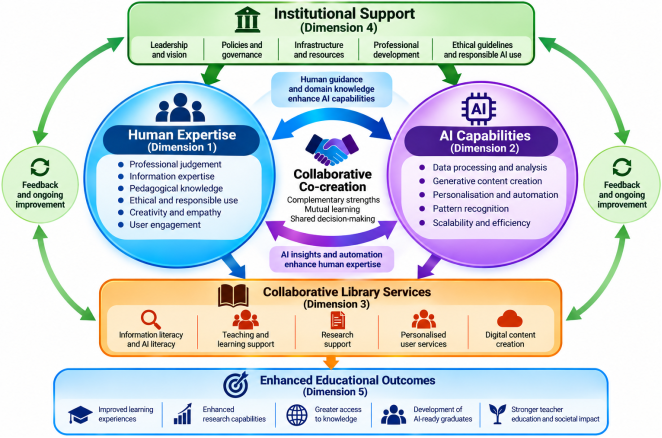
 Copy
 Download